A blackberry patch can look defeated long before it has actually given up. Goats remove leaves, daylight reaches the ground, and a wall of green begins to look more like individual canes. That change matters. It is also only part of the story. Under the surface, established crowns can remain capable of sending up new growth. The useful question is not whether goats will eat blackberry. Extension guidance and Oregon research show that they will. The question is what that browsing accomplishes, what it leaves behind, and what happens after the herd moves on.
Why does blackberry return after browsing?
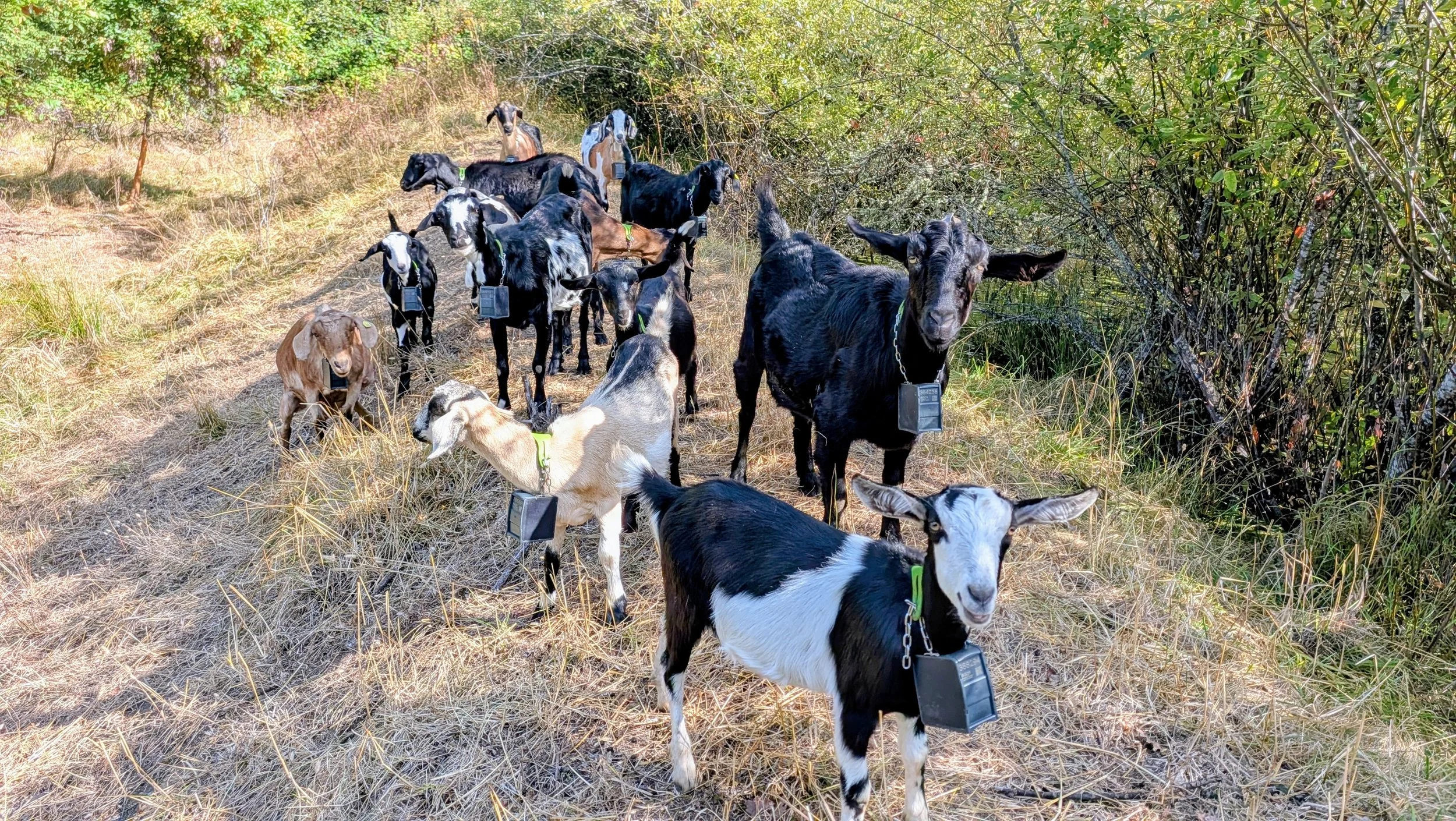
Himalayan blackberry, Rubus armeniacus, is a persistent invasive shrub in the Pacific Northwest. Oregon State University Extension describes a plant that spreads effectively through seed and keeps demanding attention after treatment. The research literature emphasizes its substantial underground crowns and vigorous regrowth. Taking away the visible canopy does not automatically remove those structures. That distinction explains why an impressive first visit and a durable change are different measures of success. A photograph can show exposed canes; it cannot show that every surviving crown has lost the ability to grow. Browsing is best understood as pressure applied to a living plant population, not a receipt proving that population has disappeared. [1, 2]
How does eating leaves weaken the plant?
OSU Extension explains the basic mechanism plainly: repeated removal of leaves reduces the plant's ability to supply its roots with food. Leaves capture energy through photosynthesis. A browsing goat interrupts that productive surface without needing to excavate the crown. New shoots may restore it, which is why repetition matters. Think of the management objective as reducing the plant's opportunities to rebuild, rather than expecting a single encounter to settle everything. This does not establish a universal number of visits or a guaranteed eradication date. It explains why timing and follow-up belong in the conversation from the start, before the first attractive before-and-after photograph is taken. [1]
What did the Willamette Valley study find?
A peer-reviewed study of invaded pasture in Oregon's southern Willamette Valley compared high-intensity, short-duration goat browsing with mowing, and with browsing followed by mowing. Researchers examined changes in plant cover after two annual treatments. Invasive blackberry cover declined significantly in all treatment groups, with no statistically significant difference among the treatment types for that response. That is real evidence for reduced cover under the conditions studied. It is not proof that every goat-grazed property will respond identically. The pasture, treatment schedule and measurement methods are part of the result. A useful summary keeps those boundaries attached: repeated browsing reduced the blackberry canopy in a field experiment, but the experiment did not establish a universal eradication recipe. [2]
Does reduced cover mean fewer living plants?
Percent cover describes how much of an area vegetation occupies when assessed using the study's methods. It is useful for understanding dominance and the space available to other plants. It is not interchangeable with underground survival, stem counts or the number of viable seeds remaining. The Oregon dissertation associated with this work considered several measures of blackberry vigor and reported continuing signs of a vigorous population, including new cane growth. Reading the cover result alongside those observations prevents a common leap: less blackberry overhead does not necessarily mean no blackberry below. Good management can still make meaningful progress while acknowledging that the surviving plants require another season of attention. [2, 3]
Will goats reach every part of a dense patch?
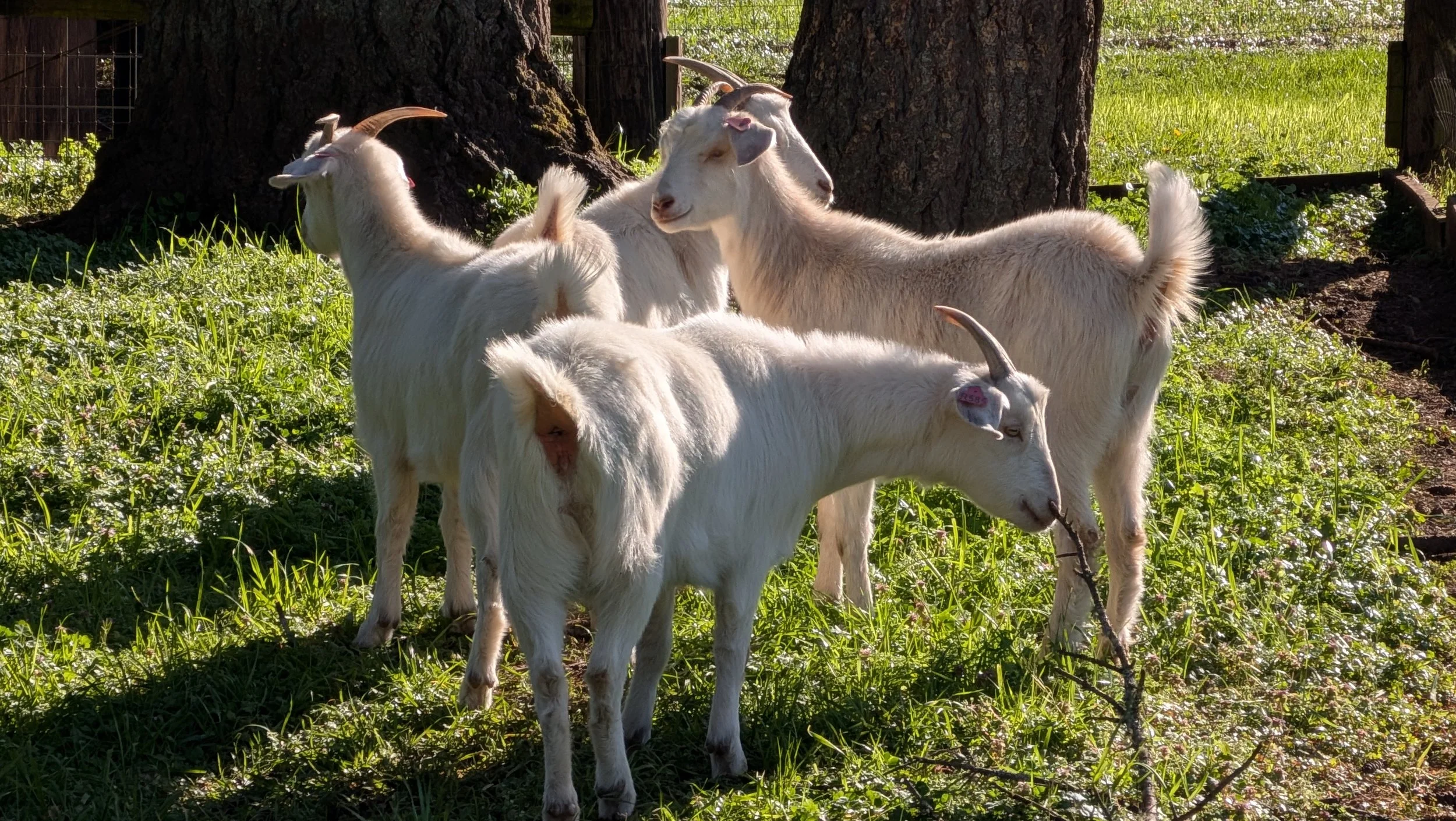
OSU Extension cautions that goats often browse around the edges of a blackberry patch. That practical observation matters because an outer ring can change quickly while the interior remains less affected. Access is therefore part of evaluating a site, not an afterthought. A grazier needs to understand where animals can travel safely and what forage they can actually reach. Dense canes, uneven ground and the arrangement of the patch can influence the result. No stocking number solves an access problem by itself. The useful planning question is specific: will the proposed grazing area let the goats browse the intended plants, rather than merely the easiest plants along the boundary? [1]
How many visits will the patch need?
Extension guidance stresses repeated effort, and the Oregon study evaluated repeated annual treatments rather than a one-afternoon demonstration. Neither source gives every landowner a fixed calendar that works regardless of conditions. The vigor of regrowth, the length of the growing season, site access and the desired vegetation all help determine what follow-up should look like. The responsible promise is a management process with reassessment, not a precise finish date borrowed from another property. If new leaves appear after browsing, that is information for the plan. It is not automatically evidence that the first treatment was useless, nor a reason to pretend that the crown is already exhausted. [1, 2]
Should every bramble be treated alike?
Plant identification should come before a grazing prescription. The Oregon paper studied Himalayan blackberry together with associated cutleaf blackberry; its results are not a blanket instruction to remove every native or cultivated bramble. A patch's identity matters to ecological goals, as does the presence of desirable plants within or beside it. A landowner who recognizes only thorny canes may miss the distinction. Use a reliable local identification resource or extension professional when uncertain. This article explains browsing science; it does not identify a particular patch from a distant photograph or from the fact that its berries are edible. [1, 2]
Will native plants return automatically?
Reducing a dominant canopy changes the competitive environment, but it does not choose every plant that follows. The Oregon study tracked annual and perennial grasses and broadleaf plants as well as blackberry. That attention to the vegetation community is important: an opening can support useful recovery, continued blackberry regrowth, or another unwanted plant. OSU Extension recommends establishing vigorous, competitive vegetation after successful control. The right species depend on the site and management goal. Simply stopping at a more open view leaves the next chapter unwritten. Restoration asks not just how much blackberry has gone, but what living cover will occupy the space and how it will be protected while it establishes. [1, 2]
Will goats leave desirable plants alone?
A goat responds to accessible forage, not to a landowner's categories of native, invasive, ornamental or valuable. OSU Extension explicitly notes that grazing can damage surrounding vegetation. That warning belongs beside the appealing pictures of goats eating thorny leaves. Desirable shrubs and young plantings may need separation from the grazing area. A practical site review should distinguish what may be browsed from what must remain untouched. The important skill is not expecting perfect animal discrimination; it is arranging the work so normal feeding behavior serves the objective. A useful herd can still create an unwanted result if the protected plants were never clearly identified or physically excluded. [1]
What is the simplest honest takeaway?
The evidence supports a middle ground more useful than either extreme. Goats can remove blackberry foliage and repeated browsing can reduce invasive blackberry cover. Established plants can regrow, seeds can arrive, and desirable vegetation can also be affected. Those statements fit together. They describe why knowledgeable planning matters and why a return visit is a feature of the method rather than an embarrassing footnote. OSU Extension's central message is persistence: do not treat a patch and then abandon it. For anyone considering goats, that is the practical starting point. Choose a clear vegetation goal, use a site-specific plan, and judge the result over time instead of asking a single photograph to tell the entire story. [1, 2]
Himalayan blackberry is a familiar problem on properties in Springfield, Eugene, and throughout Lane County. If you are considering goat grazing as part of a longer vegetation-management plan, you can outline the area you want grazed and request a free estimate.
Sources
Oregon State University Extension, "Tackling invasive Himalayan blackberry takes persistence and planning." https://extension.oregonstate.edu/news/tackling-invasive-himalayan-blackberry-takes-persistence-planning
Claudia S. Ingham, "Himalaya Blackberry (Rubus armeniacus) Response to Goat Browsing and Mowing," Invasive Plant Science and Management 7, no. 3 (2014): 532–539. https://doi.org/10.1614/IPSM-D-13-00065.1
Claudia S. Ingham, "Himalayan blackberry (Rubus armeniacus) and English ivy (Hedera helix) Response to High Intensity-Short Duration Goat Browsing," PhD dissertation, Oregon State University, 2008. https://ir.library.oregonstate.edu/downloads/3r074z36f
